Dallas carpentry
Custom carpentry in Dallas
Built-ins, window seats, wainscoting, crown and casing: the finish work that makes a room look intended.
Why trim and built-ins look wrong a year later
Finish carpentry is judged at the joint. The most common fault is a gap filled with caulk and paint where a scribed fit should be: baseboard laid against a wall that waves, a shelf side set against a plaster bow, a cabinet face pushed up against a ceiling that is not level. Caulk makes it look fine on the day it is painted. Then the house moves with the seasons, the bead splits, and a dark line appears exactly where the eye goes first.
Backing is the second fault. Casing, crown and wainscot rails nailed only into drywall have nothing solid to hold them, so nail heads pop, joints open, and a heavy chair rail starts to bow between fasteners. Built-ins fail in a related way. A bookcase or window seat built square and set against a wall that is out of plumb will rack, with doors that no longer close evenly and a face frame twisting off the line. Every inch of lean in the wall shows up again in the cabinet.
Material choice causes the third group of problems. MDF is a good, stable paint-grade board in a dry room, but it swells when it sits near a wet area, an exterior door or a laundry closet where moisture gets in at a raw edge. Soft pine dents. Cheap veneer chips at the corners. A Dallas house swings between summer humidity and a dry, heated winter, and trim that was not primed on every face moves with it. The wrong material for the room is a repair waiting to be scheduled.
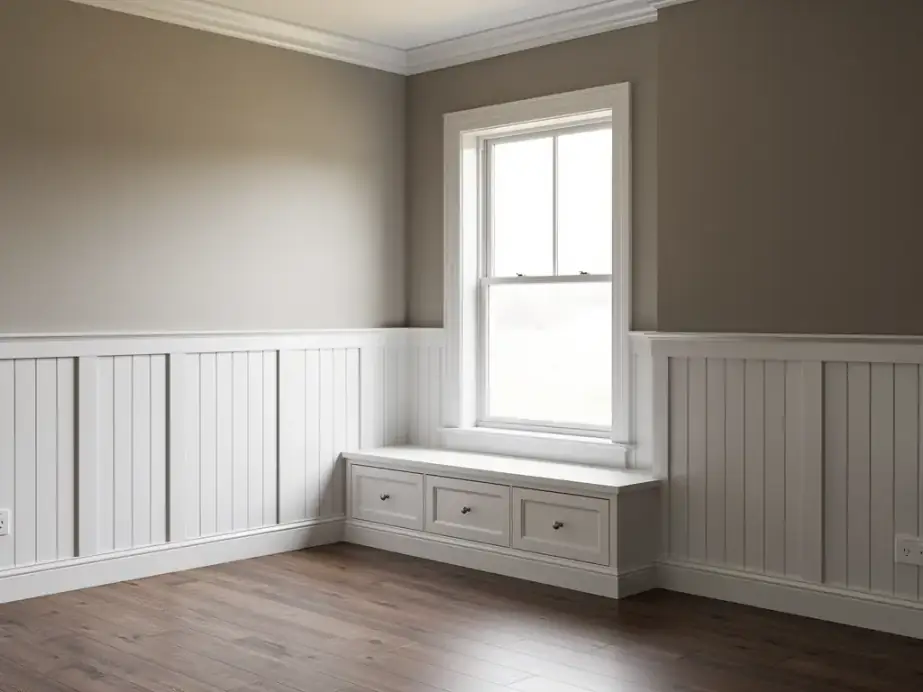
Painted board-and-batten wainscoting, crown molding and a built-in window seat with drawers
Scribed, backed and primed: how the fit is made
KD describes its carpentry as superior craftsmanship and dependability, and in trim work that begins with measuring the room before cutting a stick. Walls are checked for plumb, floors and ceilings for level, and corners for square, usually at several points rather than one. Those numbers decide how a piece will be fitted. A built-in is made to the wall it will stand against, with the cabinet sides left proud so they can be scribed to the actual surface and not forced to meet a perfect line that does not exist.
Next comes the structure behind the finish. Studs are located and blocking is added where a rail, a crown return or a heavy shelf needs something to bite into. Casing and baseboard are fastened into that framing, with glue at the joints that need it. Miters are cut to the measured angle of the corner, since most corners are not exactly ninety degrees. Pieces that will be painted are primed on every face and cut end before they go up, so moisture cannot get in through the part nobody sees.
Filler and caulk still have a place, in their proper role: nail holes, hairline seams and the narrow movement joint where trim meets a wall that will always flex a little. They are the last touch, not the way a gap is hidden. The finish coats go on after the surfaces are sanded smooth and the dust is cleaned out of the room. The aim is a window seat, wainscot or run of casing that looks as though the house had always been built that way.
How to tell trim work needs doing, and how to start with KD
Walk the room with a flashlight held flat against the wall and look along the trim. Dark lines at the top of baseboard, miters that have opened on the outside corner, nail heads showing through the paint, doors on a built-in that rub or hang unevenly, and a shelf that has begun to sag in the middle are all signs of a fit that is no longer holding. If the room has bare walls and plain openings, ask what a run of wainscot, casing or built-in shelving would do for it.
Whoever you hire for carpentry, ask how the pieces are fitted to an uneven wall, what the trim is fastened into, which material they would use near a wet area and why, and how raw edges are sealed before painting. Ask to see the joint on a finished corner, up close. A carpenter who talks about scribing, backing and priming is describing the work the way it is actually done. One who talks only about speed is describing something else.
To start with KD, call or text (682) 268-4055, email contact@kdinstallationsandremodeling.com, or send the request form on the contact page. Say what you want built or repaired, which room, and how the surrounding walls and floors behave. There is no set price list at KD, because a window seat, a wall of shelving and a full set of casing for a Dallas house are quoted on what each one needs. A short description, or a few sketches, is enough to begin.
In KD's own words: achieve superior craftsmanship and dependability. Quotes are given on request.
The carpentry sample board
Four choices that decide how a built-in or a run of trim looks and holds up.
- White oak
- Clear finish shows the grain. Pick the cut and test the stain on a scrap before committing a whole run.
- Paint-grade board
- Good for painted casing and cabinet faces in dry rooms. Keep it away from wet edges.
- Profile
- Match the crown and base profiles to the room's ceiling height, or the trim will crowd it.
- Hardware
- Drawer pulls and hinges set the tone of a built-in, and they are cheapest to choose early.