Door installation
Door installation in Dallas
Entry and interior doors hung plumb, sealed and trimmed, so they close with one hand and stay that way.
Why a door that worked last year starts to rub
The ground under most Dallas houses is expansive clay. It swells in a wet spring and shrinks in a dry August, and the house moves with it a little at a time. The first place that movement shows up is a door. A slab that rubs at the head jamb, a latch that no longer lines up with the strike plate, a gap at one top corner that was not there when the door was hung: each one tells you the opening is no longer square.
Weather is the second failure. Daylight at the weatherstrip means the seal has lost its compression, and a threshold set without a proper bed lets water in on a driving rain, where it works under the sill and softens the subfloor. Hinges are the third. When the screws go only into the jamb with no shim behind them, they pull out of soft wood under the weight of a solid door, and the slab sags a little more each season.
Interior doors fail more quietly. A bedroom door that drifts open on its own, or swings shut by itself, was hung out of plumb, and gravity is doing the job a level should have done. It is a small fault, but it is the one people notice every single day.
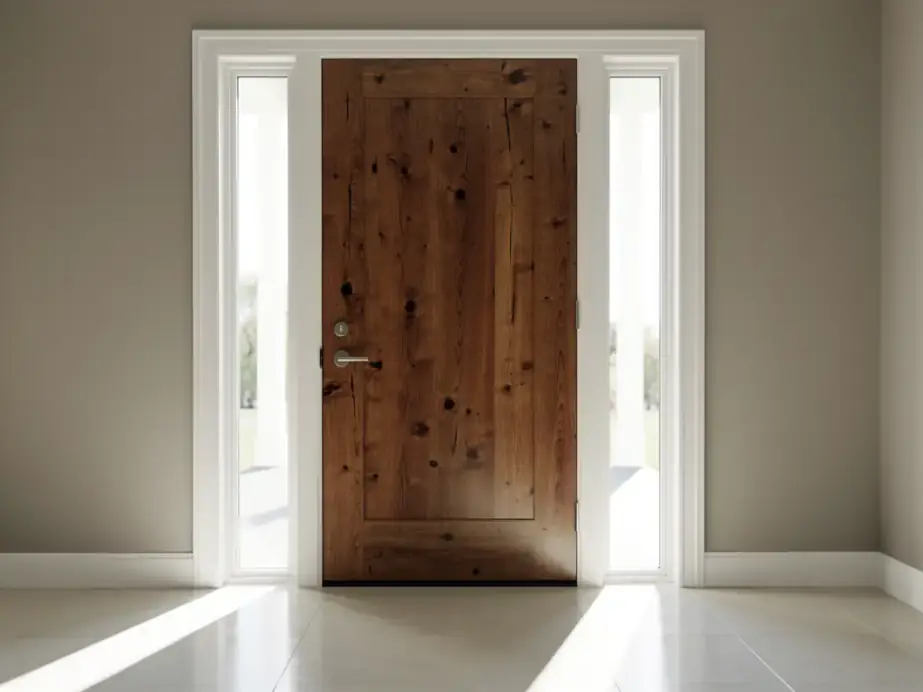
A walnut-stained wood entry door between two glass sidelites with new painted casing
How the opening is measured, shimmed and sealed
The work starts with the opening, not the door. Width and height are taken at three points, the rough opening is checked for plumb, and the diagonals are compared to see whether it is square. The floor is checked for level across the threshold. If the framing is out, that gets dealt with before a slab is lifted into place, because a door can only be as true as the opening it hangs in.
Shims go behind every hinge and at the strike, set in pairs and driven from opposite sides so the jamb is held straight instead of bowed. Long screws that reach through the jamb and bite into the framing replace the short ones that come in the hinge leaf, and that is what keeps a heavy entry door from sagging. Then the reveal is checked, an even gap all the way around, before anything is fastened for good.
An exterior door gets a sill pan or a sealant bed under the threshold, flashing tape up both sides, and a bead of sealant where the casing meets the siding so water has no path behind it. Casing goes on last, gets caulked and painted, and the finished edge reads as part of the house. In a Dallas house built before 1978, old painted casing is handled under the lead-safe practices KD is certified in: the work is contained and cleaned as it goes.
How to tell a door needs work, and how to start
Close the door on a strip of paper and pull it out at the top, the middle and the bottom on both the hinge side and the latch side. If the paper slides out easily in one spot and grips in another, the slab or the opening has moved. Other signs are a door you have to lift or shoulder to latch, light visible around the edge, a dark stain or a soft spot on the floor just inside an exterior threshold, and hinge screws that spin without tightening.
Whoever you hire, ask how the opening will be checked, what goes behind the hinges, how the threshold is sealed, and what happens to the old casing. Straight answers to those four questions tell you most of what you need to know. KD lists door installations next to custom carpentry and general contracting, so a door that also needs new trim, a widened opening or a repaired jamb can be handled as one job.
To start, call or text (682) 268-4055, email contact@kdinstallationsandremodeling.com, or send the request on the contact page with a few lines about which door it is and what it is doing. There is no set price list at KD, because a door in a sound opening and a door in a bowed one are different jobs. Quotes are given on request.
KD Installations & Remodeling, LLC is an EPA Lead-Safe Certified Firm (Renovation, Repair and Painting), certificate NAT-F154375-3.