What's Behind Your Bathroom Tile: Waterproofing Explained
The tile is the finish. What keeps your bathroom dry is everything hidden underneath it.
October 16, 2026 · 3 min read
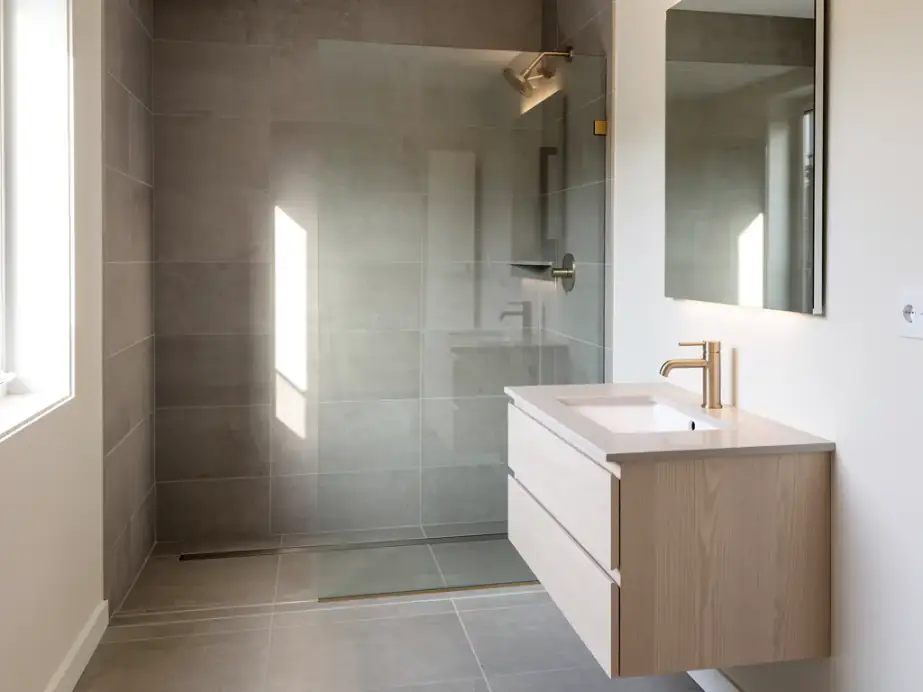
People shop for bathroom tile by color and size, and that makes sense, because that's what they'll see every day. But tile and grout aren't waterproof on their own. Water gets through grout lines, and some tile absorbs it. What actually protects your house is the layered system hidden behind and beneath the surface, and a bathroom that skips those layers can look perfect for a couple of years before it starts to fail.
The waterproofing layer
A properly built shower has a continuous waterproofing layer behind the tile. It comes in a few forms: a sheet membrane that's glued to the wall, a liquid membrane rolled or brushed on in coats, or a foam backer board system with sealed seams. They all aim at the same job, which is to stop water that passes through the tile and grout from reaching the framing.
What matters most is continuity. A membrane with gaps at corners, around the valve, at the niche or where the wall meets the floor is a membrane with a leak waiting to happen. Good installers treat every seam, penetration and corner as a spot that needs extra attention, not an afterthought.
The shower pan and its slope
The floor of a shower has to move water to the drain. That means the base beneath the tile is sloped toward the drain, and the waterproofing follows that slope. Many older showers had a mortar bed over a liner, and many newer ones use a prefabricated pan or a bonded membrane system. Either way, the slope has to be right. Too flat, and water sits in the grout lines and under the tile. Too steep, and it's uncomfortable to stand on and hard to tile neatly.
A reliable contractor will test the pan before tiling by plugging the drain, filling the pan with water and letting it sit to see if the level drops. It's a plain, low-tech check, and it's worth asking whether your installer does one.
Backer board, not drywall
Behind tile in wet areas, the wall surface should be a cement board, a foam board made for tile, or another product designed to take moisture. Standard paper-faced drywall soaks up water and turns soft, and tile on top of it will eventually loosen. Some older houses have tile set right over drywall, and those walls often hide trouble. If you're opening up a bathroom and find that, plan on replacing it rather than covering it again.
Moving the moisture out
Waterproofing handles the water that hits the walls. The exhaust fan handles the humid air. A fan only works if it's sized for the room, ducted all the way to the outdoors, and actually used. A fan that vents into the attic just moves the problem upstairs, where moisture can stain the roof deck and feed mold on the framing. If your remodel includes new ceiling work, it's the best moment to check where that duct goes and replace any crushed or disconnected run.
Signs a bathroom has a hidden leak
- A floor that feels soft or springy near the shower, tub or toilet
- Loose or hollow-sounding tile that rocks when you press on it
- Grout that keeps cracking, crumbling or turning dark even after you've cleaned and sealed it
- Staining on the ceiling or walls of the room below the bathroom
- A musty smell that doesn't go away with cleaning and ventilation
- Paint bubbling or peeling on the wall just outside the shower
- Caulk at the tub or shower base that keeps failing and pulling away
Any one of these can have a simple cause, such as worn caulk or a bad grout job. Several together, especially a soft floor or stains below, point toward water getting where it shouldn't. Don't keep re-caulking and hoping. Have someone open it up and look.
What to ask before the tile goes in
Ask which waterproofing system will be used and how the seams and corners are handled. Ask whether the shower pan gets a flood test. Ask what the walls are made of behind the tile, and where the fan will vent. These are ordinary questions, and a contractor who does careful work will be glad you asked, because the answers are the part of the job you won't be able to see once the tile is up.
If you're planning a bathroom remodel, call or text KD Installations & Remodeling in Dallas at (682) 268-4055, or email contact@kdinstallationsandremodeling.com, to request a quote.
KD Installations & Remodeling, LLC, (682) 268-4055
Call (682) 268-4055More articles
Remodeling a Pre-1978 Dallas Home: Lead-Safe Basics
If your house predates 1978, the dust from a remodel matters as much as the finished room.
Kitchen Remodel or Refresh? How to Decide Before You Call
The difference between a refresh and a remodel usually comes down to whether the layout is the problem.